PRIMARY AUDIENCE
Website visitors asking about custom software engineering, architecture, cloud choices, technology orchestration, and documented Neubofy services; also visitors who need to be directed to a human support channel.
A technical concierge that answers from a maintained knowledge base, not a blank prompt.
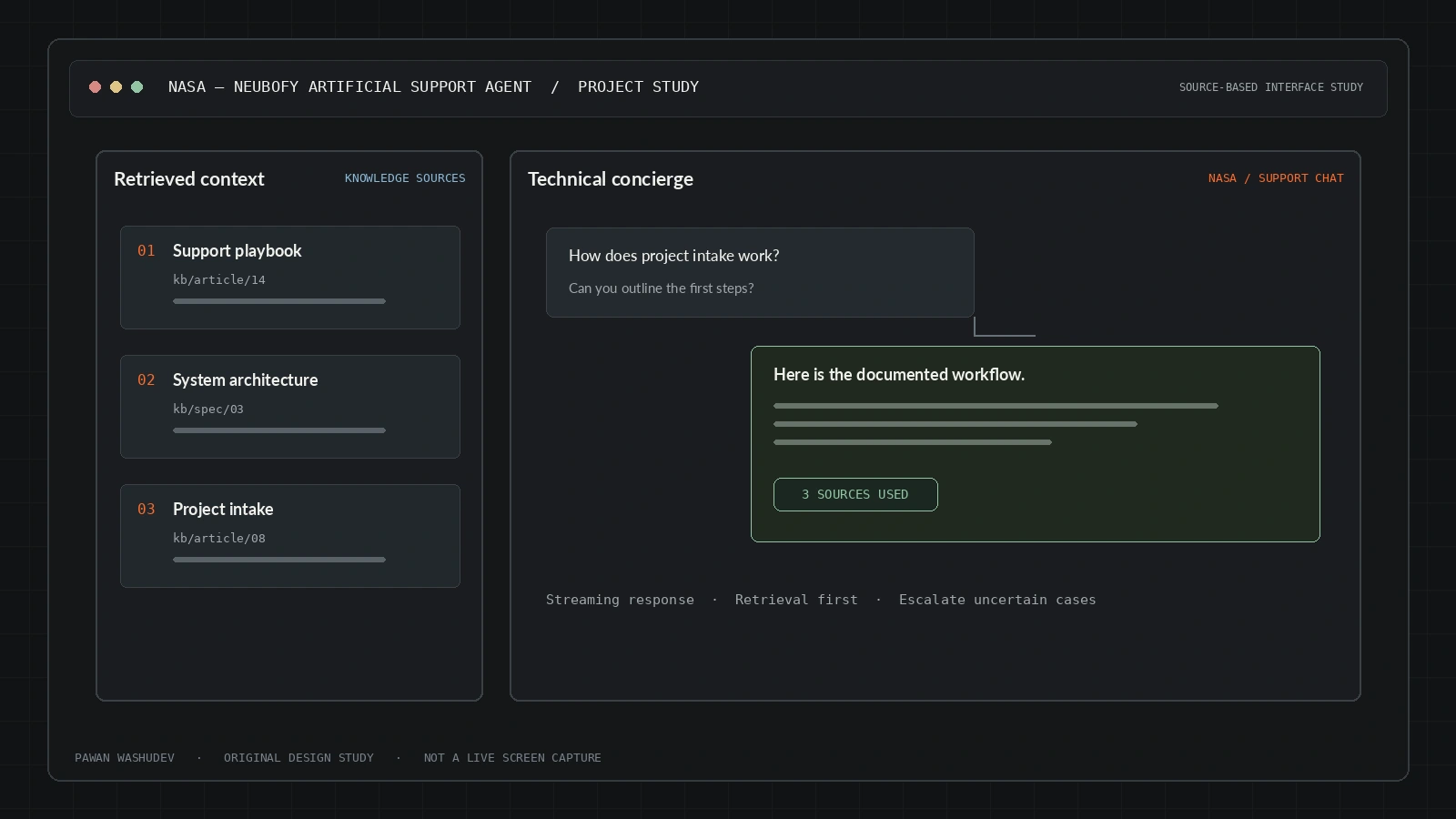
The most useful way to understand this project is to start with the friction behind it, then examine the system choices made to address that friction.
A technical support assistant needs more than a language model: it needs the organization’s specific service definitions, architecture context, support boundaries, and a safe route to a human when the question is too complex. Repeating the same foundational answers manually also scales poorly.
NASA is designed as an edge-native support layer for Neubofy. The frontend can be embedded with a single script tag; the Worker retrieves semantically relevant knowledge from a Vectorize index and streams an answer using Workers AI. A stateless runtime model avoids keeping a long-lived per-chat server object, and a documented optimization skips embedding retrieval for trivial greetings.
A strong implementation has a bounded audience and context. These are the use cases supported by the current design—not a claim that all of them have been validated at scale.
Website visitors asking about custom software engineering, architecture, cloud choices, technology orchestration, and documented Neubofy services; also visitors who need to be directed to a human support channel.
An overview of key capabilities and system features.
The documented snippet loads `https://nasa.neubofy.in/widget.js` and can be used with static HTML or Next.js.
Queries the `neubofy-kb-index` Vectorize index to collect relevant source context.
The README describes streaming responses from the Worker runtime.
The assistant focuses on engineering, cloud architecture, playbooks, and project scoping.
The repository describes structured organization metadata and open-graph/answer-engine markup.
Architecture and system flow overview.
Opens the standalone assistant or a site with the widget script.
Sends the user prompt and manages the chat interface.
Orchestrates retrieval, prompt construction, model call, and streaming.
Retrieval supplies knowledge context; the model composes an answer that is returned to the visitor.
Cloudflare Workers, Workers AI, Cloudflare Vectorize, React 19, Vite, AI SDK, Cloudflare Agents packages, TypeScript, server-served widget.js.
Engineering choices and design decisions behind the implementation.
Key technical details and system scope considerations.
The next step is not simply adding features. It is increasing reliability, evidence quality, user trust, and clarity about the boundaries of the system.
Add user-visible citations/source snippets to knowledge-grounded answers.
Run adversarial retrieval tests for stale articles, prompt injection in source content, and unsupported claims.
Publish a clear retention statement and monitor response quality without collecting unnecessary conversation content.
Project repositories and resource links.