PRIMARY AUDIENCE
Readers of technical playbooks, prospective clients exploring engineering approaches, internal editors and contributors, and the NASA assistant that retrieves relevant knowledge.
One publishing engine for technical playbooks, specifications, and native HTML mini-sites.
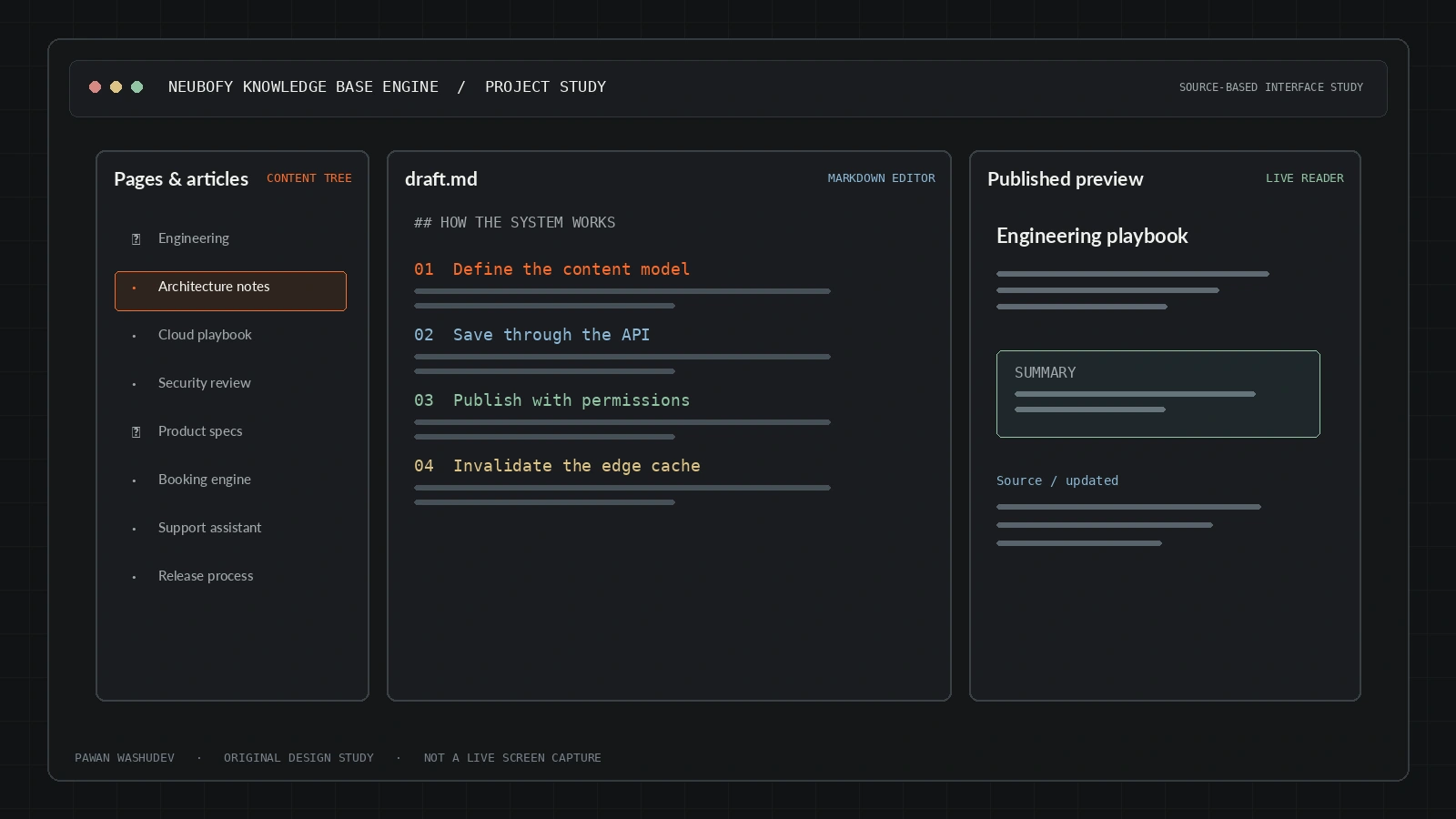
The most useful way to understand this project is to start with the friction behind it, then examine the system choices made to address that friction.
A conventional blog or static markdown folder is awkward when technical documentation and campaign-specific mini-sites need separate publishing rules, permissions, and rendering. Content also has limited reuse if each frontend has to rebuild its own content-management logic.
I designed the Knowledge Base as an edge-native, decoupled publishing engine. It separates writing and governance from public rendering and supports two kinds of content: structured Markdown articles for playbooks/specifications, and full HTML pages for unconstrained landing-page experiences. The same knowledge base can support human readers and provide material for retrieval-based AI support.
A strong implementation has a bounded audience and context. These are the use cases supported by the current design—not a claim that all of them have been validated at scale.
Readers of technical playbooks, prospective clients exploring engineering approaches, internal editors and contributors, and the NASA assistant that retrieves relevant knowledge.
An overview of key capabilities and system features.
Markdown articles can render syntax-highlighted code blocks, TOCs, summaries, and structured metadata.
Raw HTML documents can be managed as mini-sites rather than constrained inside a markdown template.
Role-based permissions, content management, draft/publication workflows, and audit logs.
The README documents password, WebAuthn passkeys, magic links, GitHub OAuth, and Google OAuth pathways.
Cloudflare D1 stores structured data; the Worker API and cache layer serve public content.
NASA’s retrieval index is described as a separate Vectorize layer that can fetch semantically relevant information.
Architecture and system flow overview.
React/Vite administrative SPA on Cloudflare Pages.
Hono Worker handles access checks, validation, content endpoints, and cache control.
Drizzle ORM maps application data to Cloudflare D1.
Next.js renders articles/HTML pages; published knowledge can also feed the NASA Vectorize index.
Cloudflare Workers, Hono, D1, Drizzle ORM, Cloudflare Pages, React 18, Vite, React Query, Next.js 15 / React 19 on the public reader, Cloudflare Vectorize for AI retrieval.
Engineering choices and design decisions behind the implementation.
Key technical details and system scope considerations.
The next step is not simply adding features. It is increasing reliability, evidence quality, user trust, and clarity about the boundaries of the system.
Publish a redacted architecture diagram and test methodology for performance/security claims.
Track content freshness and ownership for each public article.
Make the publishing-to-vector-index refresh path observable so AI answers can be traced to updated sources.
Project repositories and resource links.