Founders and small teams evaluating a product idea; operators replacing fragmented tools; organizations needing architecture review or implementation direction; and teams that need a clear technical plan before committing to a full-time department.
Neubofy
Business platform
A technology department without the overhead of building one.

The problem I chose to solve
The most useful way to understand this project is to start with the friction behind it, then examine the system choices made to address that friction.
Many founders know the business outcome they want before they know which stack, specialist, or implementation path is right. Conventional agency framing can start with a predefined service list; hiring an entire technical department is expensive before the need is understood. Neubofy’s central problem is the gap between a business objective and a coherent, safely delivered technology system.
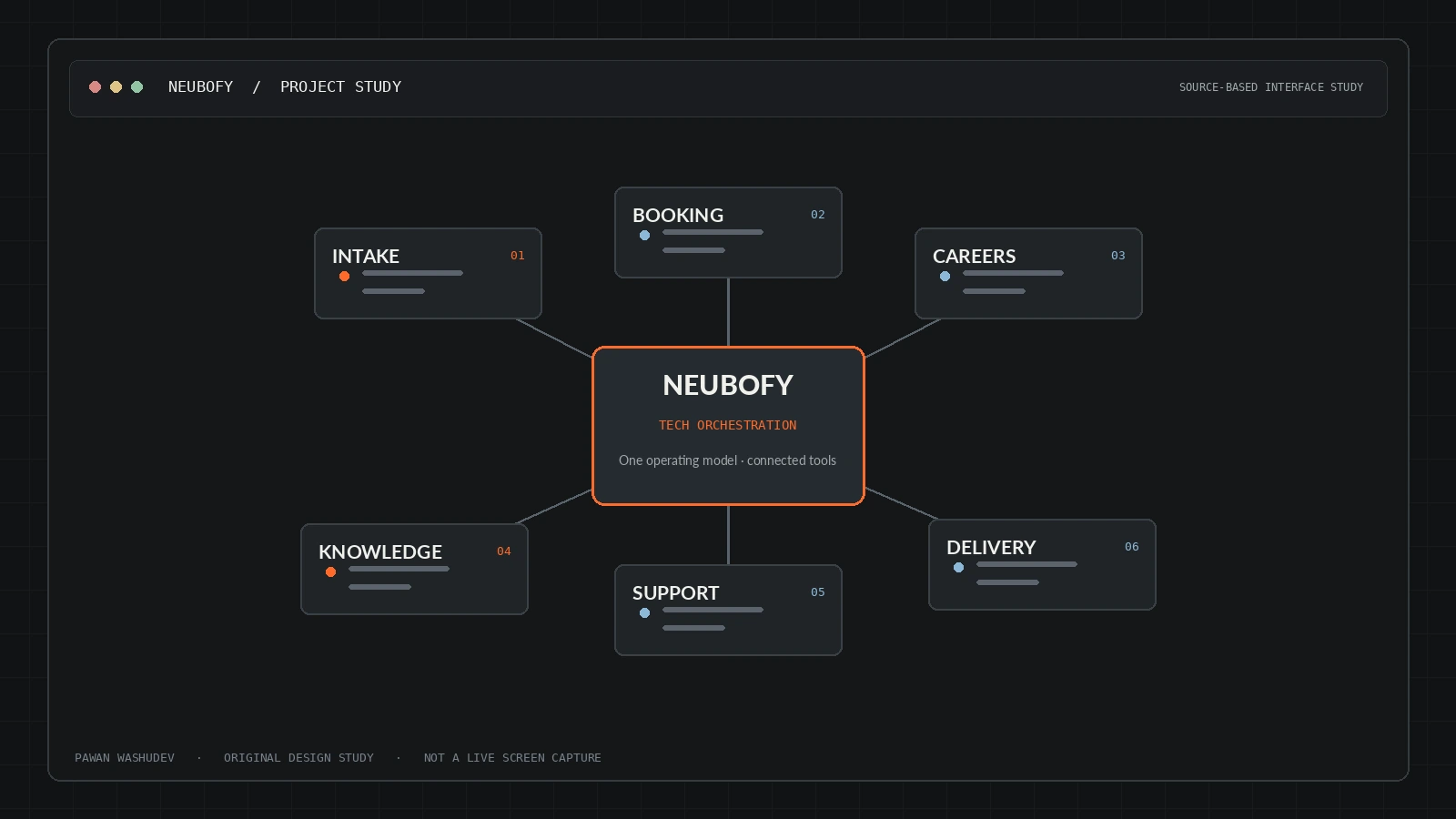
I position Neubofy as a technology orchestration layer: start with the problem, assemble the right technical approach, and coordinate people, tools, and delivery rather than forcing every request into one fixed product or framework. The public site expresses this through capability explanations, production-verification thinking, scenario exploration, and comparative economics rather than only a generic services grid.
Where it fits in the real world
A strong implementation has a bounded audience and context. These are the use cases supported by the current design—not a claim that all of them have been validated at scale.
- Problem-first discovery before stack selection
- Architecture and specialist work are treated as coordinated parts of one delivery system
- A growing operating surface for intake, scheduling, documentation, hiring, and support
- Public explanations are designed to help a buyer reason about trade-offs instead of promising a universal solution
What the system actually does
An overview of key capabilities and system features.
Positioning and scenario education
The main site explains the orchestration model, target audiences, comparative economics, and production-verification concepts.
Structured intake
A dedicated start page collects objectives and context before a conversation begins.
Knowledge publishing
Technical playbooks and system specifications are delivered through the custom Knowledge Base engine.
Scheduling and support
Booking and NASA provide distinct paths for consultation scheduling and immediate technical questions.
Talent workflow
The careers and admin areas support recruiting and internal coordination.
Architecture & data flow
Architecture and system flow overview.
Business goal
A founder or team starts with an outcome, constraint, or unresolved technical decision.
Intake & triage
The public site captures context; the inquiry is organized for human review.
Architecture & orchestration
Options, dependencies, risks, and the required expertise are mapped to the problem.
Delivery ecosystem
Specialists, implementation tools, documentation, review, and ongoing support are coordinated.
Next.js / React / TypeScript; Firebase-related application infrastructure; Cloudflare-backed content and edge services; connected scheduling and support systems.
Decisions behind the implementation
Engineering choices and design decisions behind the implementation.
- Keep the business proposition broader than a single programming language or framework.
- Separate public education from operational portals so each workflow can evolve without rewriting the main marketing page.
- Use an integrated set of focused systems rather than one monolithic back office: intake, booking, KB, careers, and AI support have distinct responsibilities.
Technical Considerations
Key technical details and system scope considerations.
- This is a technology-orchestration model, not a claim that every service or integration is continuously staffed or universally available.
- The codebase is private; public pages establish the product positioning but do not expose every operational detail.
- Before publishing commercial claims, keep them tied to verified outcomes, named deliverables, and the current capacity of the team.
What I would improve next
The next step is not simply adding features. It is increasing reliability, evidence quality, user trust, and clarity about the boundaries of the system.
Publish selected architecture case studies with permission and redacted diagrams.
Add dated delivery evidence and measured results only where a real project outcome can be substantiated.
Keep the status of each connected system visible so public visitors can distinguish live workflows from planned capabilities.
Sources & Resources
Project repositories and resource links.