PRIMARY AUDIENCE
Power users with watches in the Moyoung / Da Fit-compatible family—potentially including some GoBoult, Drift, Colmi, and Fire-Boltt devices—who are comfortable testing an alternative companion app.
A native Android alternative for specific Da Fit-compatible wearables, with local-first sync and phone-finding tools.
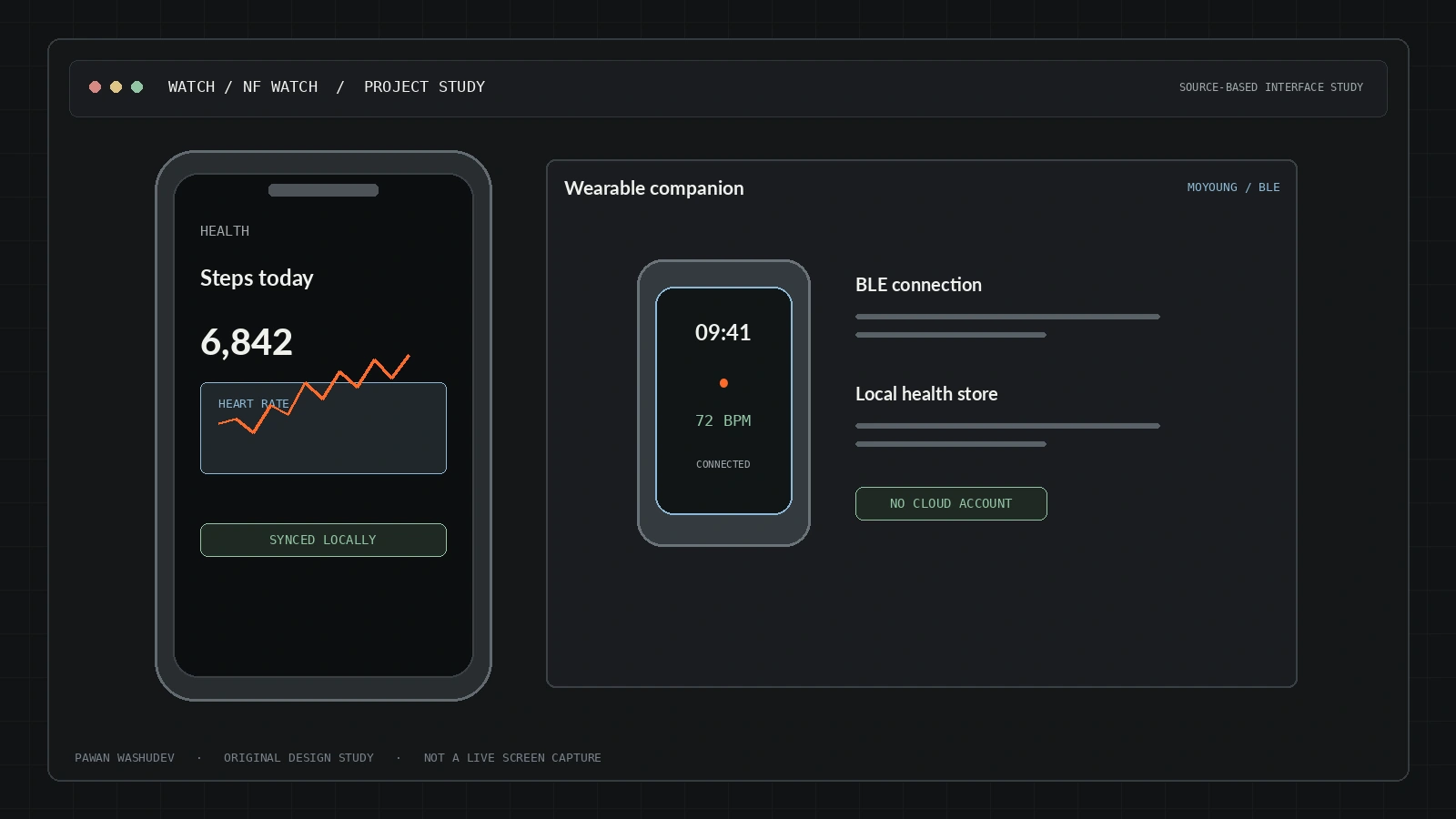
The most useful way to understand this project is to start with the friction behind it, then examine the system choices made to address that friction.
Many budget smartwatches rely on a vendor companion app that may have limited user control, inconsistent background reconnection, or a cloud-connected experience. The connection protocol can also be a hidden barrier to building a better companion app for a family of devices.
Watch implements the Moyoung / Da Fit Bluetooth Low Energy protocol in a native Kotlin application. The approach is to control the BLE connection lifecycle, local persistence, Health Connect handoff, and phone-finding SOS behavior directly in Android, while keeping the documented health-related data offline rather than requiring a separate vendor account.
A strong implementation has a bounded audience and context. These are the use cases supported by the current design—not a claim that all of them have been validated at scale.
Power users with watches in the Moyoung / Da Fit-compatible family—potentially including some GoBoult, Drift, Colmi, and Fire-Boltt devices—who are comfortable testing an alternative companion app.
An overview of key capabilities and system features.
Specialized GATT auto-connect and reconnection recovery logic.
Watch-triggered alert mode with sound and synchronized flashlight/vibration behavior.
Two-way integration with Android’s health data store is documented.
Room and DataStore support device-side state.
Jetpack Compose / Material 3 UI with a dark glassmorphism visual direction.
Architecture and system flow overview.
Wearable advertises a BLE profile understood by the app.
The Kotlin app establishes and maintains GATT communication.
Room/DataStore persists configuration and supported readings.
Health Connect sync and SOS phone controls use platform APIs and permissions.
Kotlin, Jetpack Compose, BLE GATT / Moyoung protocol, Room, DataStore, WorkManager, Android Health Connect, R8/ProGuard.
Engineering choices and design decisions behind the implementation.
Key technical details and system scope considerations.
The next step is not simply adding features. It is increasing reliability, evidence quality, user trust, and clarity about the boundaries of the system.
Maintain a tested watch/phone/Android-version matrix.
Add reproducible BLE logs with personal identifiers stripped out.
Validate SOS stop and notification behavior for accessibility, safety, and platform compliance.
Project repositories and resource links.