PRIMARY AUDIENCE
School leadership and staff evaluating a modern public web presence; families exploring school information only after the current content has been reviewed by the institution.
An animated institutional web concept for Students Public School in Bihta.
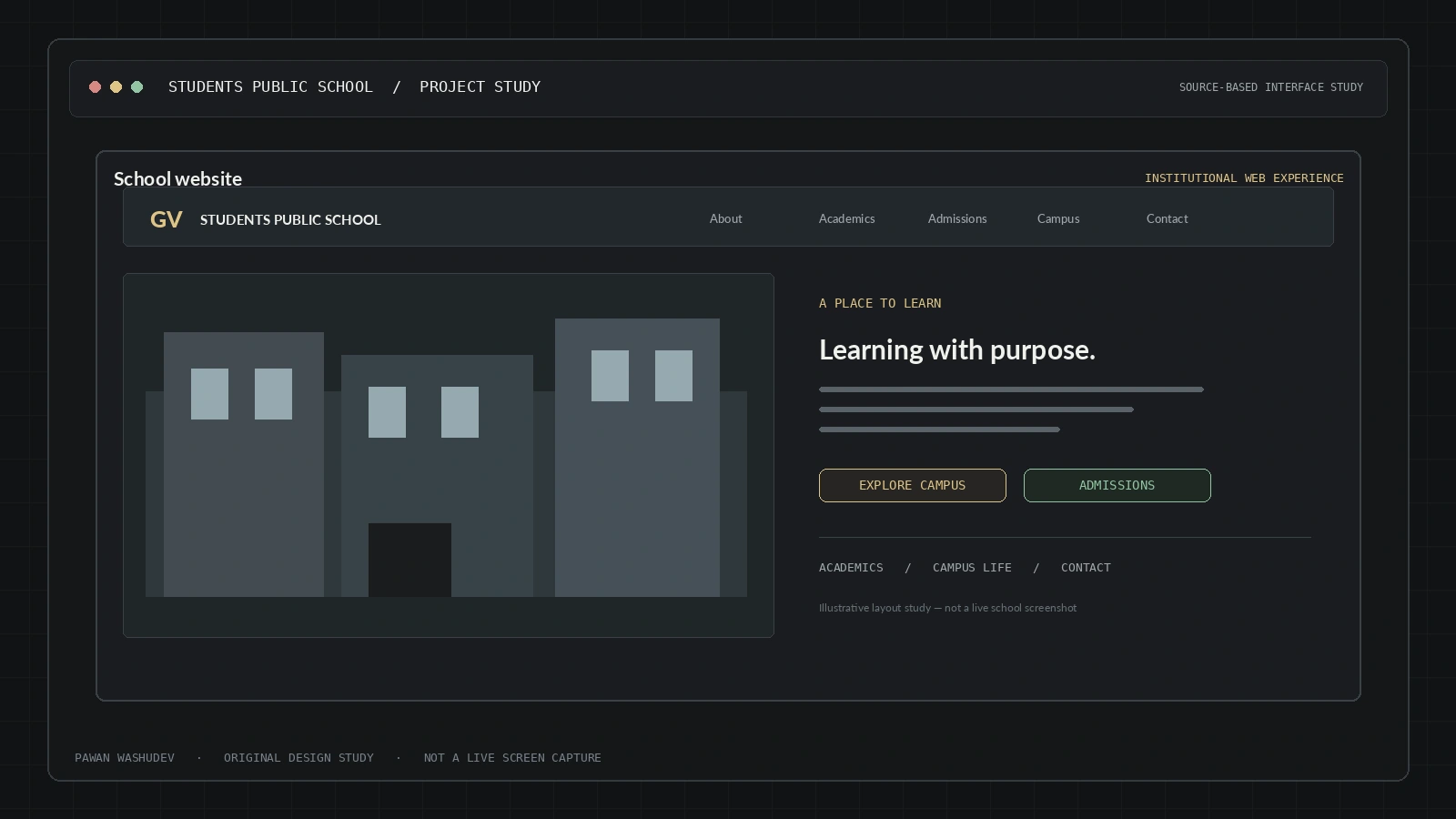
The most useful way to understand this project is to start with the friction behind it, then examine the system choices made to address that friction.
School websites need to turn a broad institutional story into clear sections: about the school, academic approach, student achievements, campus life, admissions, and contact. Repeated or poorly prioritized information makes this harder for families to evaluate.
This project explores a high-impact landing page for Students Public School, with a large hero, campus pulse, hall of fame, academic excellence, admissions, and contact sections. The source demonstrates intentional motion and reusable components. Because the current hosted version contains placeholder metrics and outdated academic session references, it should be presented as a design/engineering prototype until the school confirms the copy.
A strong implementation has a bounded audience and context. These are the use cases supported by the current design—not a claim that all of them have been validated at scale.
School leadership and staff evaluating a modern public web presence; families exploring school information only after the current content has been reviewed by the institution.
An overview of key capabilities and system features.
A high-visual opening section positions the school and routes visitors to campus or admissions sections.
Dedicated component for curriculum/academic narrative.
A distinct area for achievements, intended to be populated by approved content.
Routes visitors toward inquiry and application-related information.
Framer Motion handles animation and scroll transformations.
Architecture and system flow overview.
Opens the Vercel-hosted school website.
App Router assembles the home-page component sequence.
About, achievements, campus pulse, academics, admissions, and contact are independently composed.
Contact/admissions call-to-actions are visible; any downstream submissions need direct production validation.
Next.js, React, TypeScript, Framer Motion, CSS modules, reusable React components.
Engineering choices and design decisions behind the implementation.
Key technical details and system scope considerations.
The next step is not simply adding features. It is increasing reliability, evidence quality, user trust, and clarity about the boundaries of the system.
Obtain approved up-to-date copy, school contact data, current session dates, and genuine metrics.
Test all enquiry/admission forms and ensure submissions reach the correct school staff.
Keep this out of a “live client launch” list until official ownership and current content are verified.
Project repositories and resource links.