PRIMARY AUDIENCE
People managing their own Android phone and who want an additional recovery/control path beyond the OS vendor’s default tools. Deploy only on devices you own or have explicit permission to manage.
A multi-channel toolkit for locating, alerting, and managing your own lost Android device.
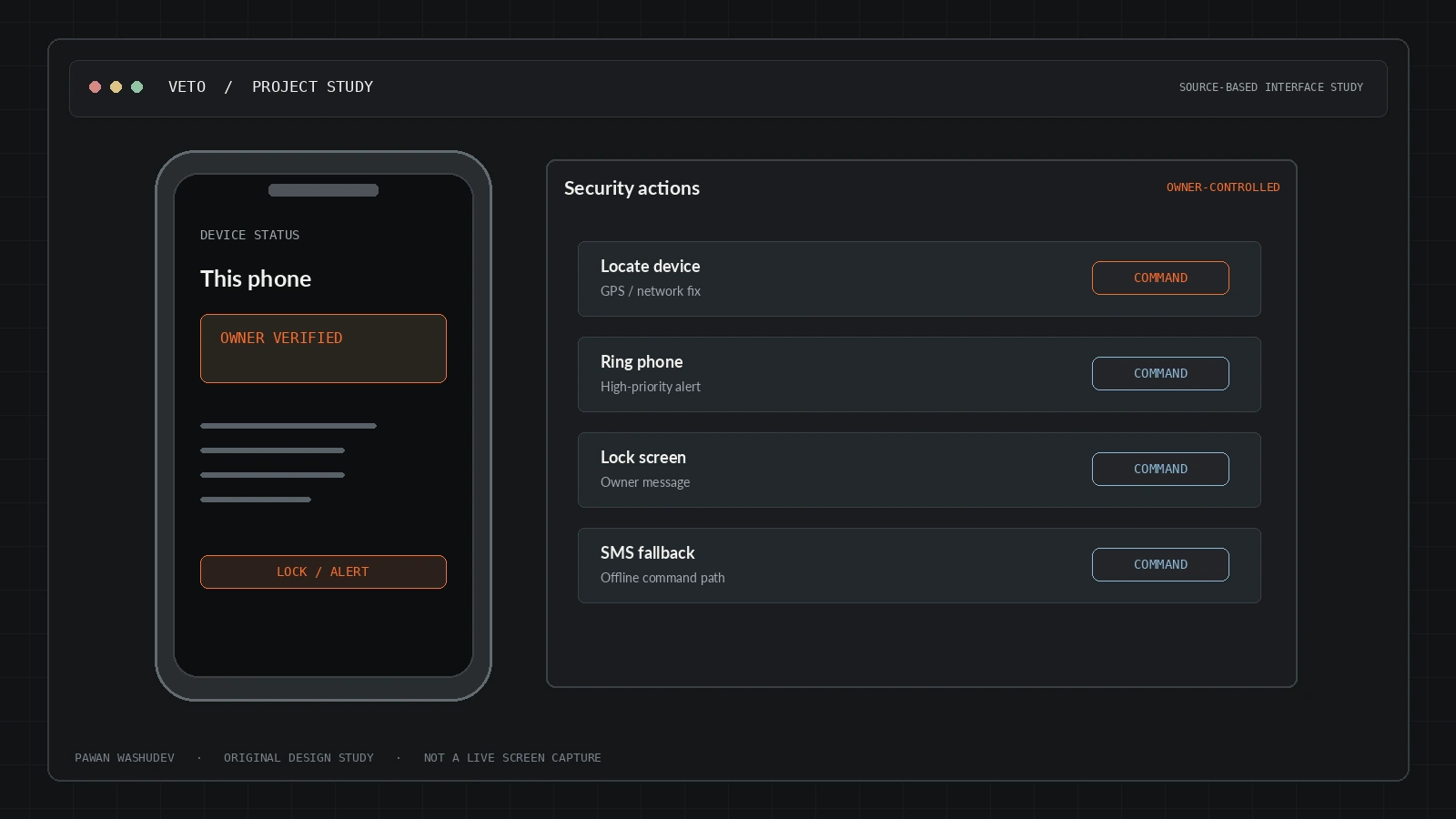
The most useful way to understand this project is to start with the friction behind it, then examine the system choices made to address that friction.
A lost phone is difficult to recover if one control channel fails. A cloud-only tracker cannot help when mobile data is unavailable, and an alert that can be easily muted is weak at drawing attention. Device recovery also needs an owner-controlled authorization model because the same capabilities can be misused if they are covert or unauthenticated.
Veto is an Android security and recovery project built around transport redundancy. The documented design combines a web dashboard and push delivery with SMS-based control paths, validates commands on the device, and routes permitted actions through native Android capabilities. The strongest defensible public story is reliability under different connectivity conditions—not surveillance.
A strong implementation has a bounded audience and context. These are the use cases supported by the current design—not a claim that all of them have been validated at scale.
People managing their own Android phone and who want an additional recovery/control path beyond the OS vendor’s default tools. Deploy only on devices you own or have explicit permission to manage.
An overview of key capabilities and system features.
The app documents location retrieval and a high-volume alert flow.
A combined response can coordinate device alerting and configured recovery actions.
SMS provides a fallback when internet connectivity is not available, subject to carrier and Android permission restrictions.
The website describes command dispatch, maps, telemetry, and media handling.
The README discusses AES-GCM command encryption, PIN protection, allowlisting, and salted PIN verification.
Optional uploads to a Google Drive account are documented; review consent, storage, and access controls carefully.
Architecture and system flow overview.
The authorized owner issues a command through the web interface or an allowed SMS path.
Firebase Cloud Messaging / SMS / notification paths deliver an instruction when the matching service is configured.
The Kotlin client checks the configured PIN/allowlist/encryption rules before interpreting a request.
Android location, alarm, lock, or media capability runs within OS and permission limits.
Kotlin / Android, Next.js dashboard, Firebase Auth / Firestore / FCM, native SMS receivers, Android device policy/accessibility APIs, Google Drive integration, encryption and PIN-verification routines.
Engineering choices and design decisions behind the implementation.
Key technical details and system scope considerations.
The next step is not simply adding features. It is increasing reliability, evidence quality, user trust, and clarity about the boundaries of the system.
Align the public website version with the actual release/build channel.
Publish a permission and consent matrix, with user-visible indicators and audit events for sensitive actions.
Test lost-network, SIM-change, OS permission revocation, reboot, battery optimization, and failed command-delivery cases.
Document what media is uploaded and how it is retained or deleted.
Project repositories and resource links.